MECH 4692, Renewable & Sustainable Energy Design
RED House Net-Zero Energy Retrofit
An integrated renewable-energy retrofit that raises an existing Winnipeg home from 20 to 99.9 percent renewable within budget.
20.1 to 99.9%
Renewable Energy Ratio
7,688 to ~0 kg/yr
GHG emissions
$86,699 of $100k
Capital cost
+$41,627
30-year net profit
173.8 GJ/yr
Renewable generation
Overview
A whole-home energy retrofit to make an existing Winnipeg house fossil-fuel-free. Solar PV, solar thermal, wind, battery and thermal storage, a biomass stove, and an EV raise the Renewable Energy Ratio from 20.1 to 99.9 percent and reduce about 7,688 kg CO2e/yr to near zero, for $86,699 against a $100,000 budget, with a positive 30-year cash flow.
Problem
The RED House brief: retrofit an existing Winnipeg home to be fossil-fuel-free on a $100,000 budget, while keeping the hydro grid and natural-gas connections for resiliency and supporting multi-month off-grid operation each year.
The baseline home consumed 174.07 GJ/yr and emitted about 7,688 kg CO2e/yr, dominated by natural gas (4,771 kg) and gasoline (2,389 kg), for a Renewable Energy Ratio of 20.1 percent.
Energy-Load Analysis
Electricity and natural-gas loads were normalized from monthly data to an hourly basis and extrapolated across the year. Heating load was driven by the indoor-outdoor temperature differential using 2014 hourly MET temperature data, and gasoline and propane loads came from vehicle and appliance usage.
This hourly baseline became the demand profile that every generation and storage subsystem was sized against.
Renewable Generation Design
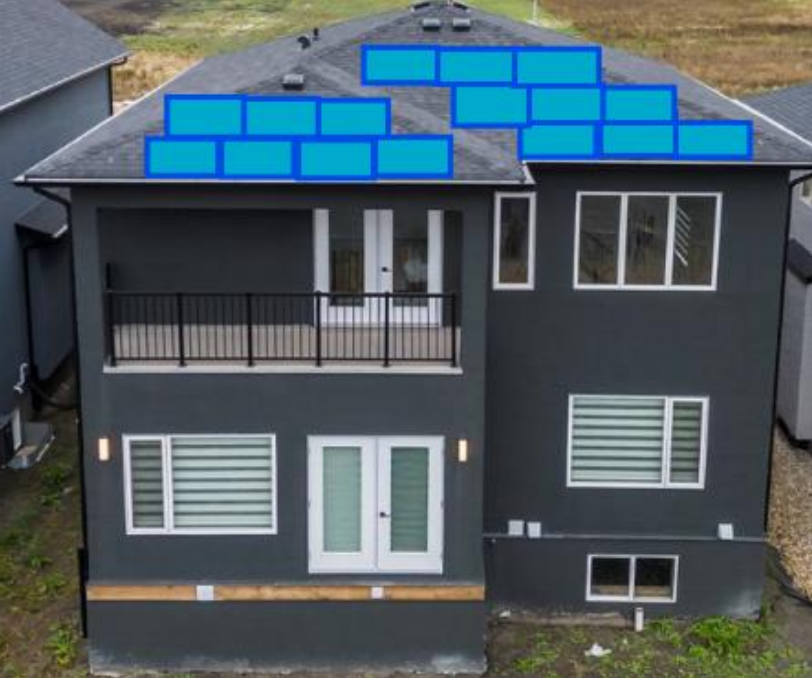
Solar PV: 12 Canadian Solar TOPHiKu6 470 W N-type TOPCon panels (5.64 kW), tilted 45 degrees south, generating an estimated 22.52 GJ/yr after a 97 percent DC-to-AC conversion.
Solar thermal: 3 ThermoRay TRB-30 flat-plate collectors at a 50 degree tilt, at 57.7 percent net recovery efficiency, delivering an estimated 158.31 GJ/yr, which covers most of the space- and water-heating load.
Wind: 16 Primus AIR 40 micro-turbines. The Winnipeg wind resource was characterized from 8,760 hourly observations (mean 4.59 m/s; Weibull k = 2.086, c = 4.02 m/s), and the turbine power curve was integrated over the velocity histogram with altitude- and temperature-corrected air density and Region I/II/III control logic, yielding about 305 kWh/yr per unit. Wind output is anti-correlated with solar, stronger on cold, cloudy days.
Storage, Controls & Biomass
A 9.9 kWh LiFePO4 battery (90 percent round-trip) and a hot-water thermal buffer tank balance the hourly mismatch between generation and demand. The control logic prioritizes local renewable self-consumption, charges the battery with surplus, exports the remainder to Manitoba Hydro, and meets deficits from battery first then grid, reaching net-zero grid interaction (minus $5.01/yr in Year 1).
A Nissan LEAF EV replaces the gasoline car, removing 34.47 GJ/yr of fuel and acting as a controllable load scheduled for high-generation hours. A Sedore Canadian 2000 multi-fuel stove provides winter space heat. A first-principles combustion analysis (5.66 kg air per kg dry fuel, 45 percent excess air, flue gas exiting at 315 C) gave a 57.7 percent net recovery efficiency and about 1,484 kW of useful heat from roughly 2.07 cords of wood per year.
Budget & Economics
Capital cost totalled $86,699, $13,301 under the $100,000 ceiling, split across solar PV ($3,600), solar thermal ($12,600), the EV ($20,000), battery storage ($14,000), wind turbines ($32,000), and the biomass stove ($4,499).
A 30-year discounted cash-flow analysis, fed by avoided electricity, gas, and gasoline costs, turns cash-flow positive in Year 22 and reaches a cumulative net profit of $41,627 by Year 30.
Outcome & Key Learnings
Combined renewable generation, solar PV (22.52), solar thermal (158.31), wind (1.10), and EV gasoline displacement (8.10), totals 173.83 GJ/yr against the 174.07 GJ/yr load, raising the Renewable Energy Ratio from 20.1 to 99.9 percent and cutting emissions to near zero while staying on budget and meeting the off-grid requirement.
No single technology was sufficient alone. Solar thermal carried the heating load, wind backfilled solar's weakest days, and storage with a grid-as-battery strategy reconciled supply and demand hour by hour. Designing the system as a coordinated whole, and proving it over 30 years, was what met the net-zero target within the constraints.
Image Gallery
Additional renders, drawings, and analysis outputs from the project.
Next project
Hovercraft Aerodynamic Optimization