MECH 4360, Biomaterials Design
Eggshell-Alginate Microspheres
Waste-derived bioactive microspheres for bone tissue engineering, characterized across mechanical and chemical properties.
1.0-2.0 wt%
Alginate concentration
3-6 wt%
CaCl2 crosslinker
0-10 wt%
Eggshell filler
4
Characterization methods
Overview
Development and characterization of eggshell-incorporated alginate microspheres as a low-cost scaffold for bone tissue engineering. Eggshell food-waste supplies bioactive calcium; the microspheres were fabricated by ionic crosslinking and evaluated with FTIR, compression testing, rheology, and electrospinning.
Problem
Bone defects from trauma, surgery, and degenerative disease are a clinical burden, with millions of fractures annually needing scaffolds. Alginate microspheres are used in bone tissue engineering but are limited in mechanical strength, cost, and sustainability.
This project evaluated eggshell-incorporated alginate microspheres. Reusing eggshell food-waste as a calcium- and hydroxyapatite-rich bioactive filler targets improved mechanical performance and osteogenic potential while reusing a byproduct.
Fabrication
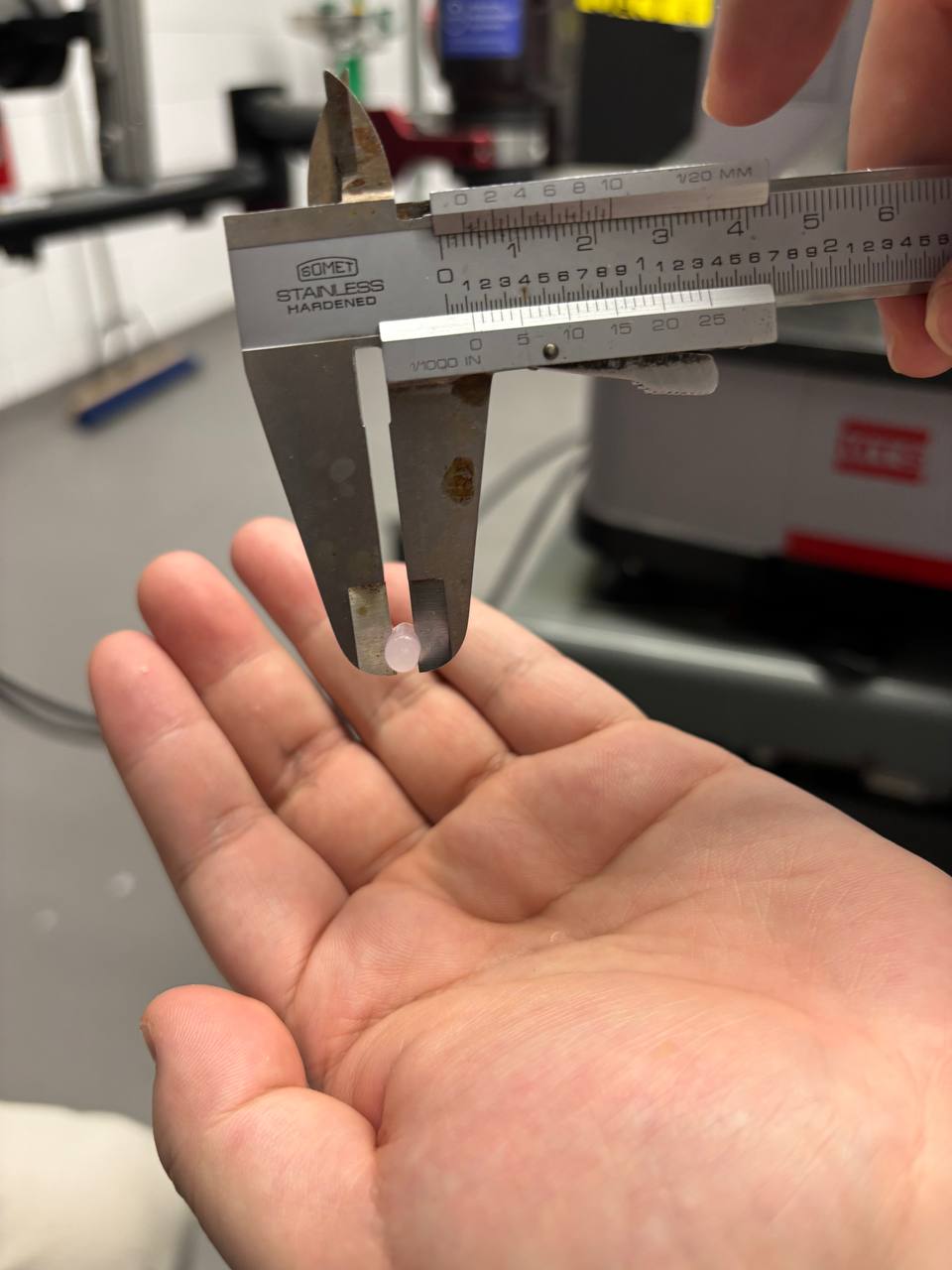
Microspheres were formed by ionic crosslinking, extruding aqueous sodium alginate (1.0-2.0 wt%) into a calcium chloride bath (3-6 wt%), where divalent Ca2+ ions chelate the alginate backbone into an egg-box gel network. Eggshell powder (0-10 wt%) was added as a second internal Ca2+ source.
Eggshell was ground with a mortar and pestle, and electrospinning was trialed to produce more uniform, size-controlled spheres by varying applied voltage.
Characterization & Findings
FTIR spectroscopy confirmed the chemistry. O-H, N-H, C=C, C-C, and C-N peaks verified that alginate, calcium chloride, and eggshell were incorporated across the tested formulations.
Compression and rheology used a 2 wt% alginate, 6 wt% CaCl2 baseline. Adding 10 wt% eggshell raised the storage modulus (G') and improved compressive performance, and the 2ALG6CA10ES samples showed a viscous-to-elastic G'/G'' crossover under dynamic loading. Coarse mortar-ground particles caused non-uniform samples and scattered results.
Electrospinning improved uniformity for plain alginate but failed for eggshell suspensions, which were too coarse to pass through the needle, identifying particle-size control as the key process variable.
Outcome & Key Learnings
The work showed that waste-derived eggshell-alginate microspheres are a feasible scaffold material, with eggshell providing measurable mechanical reinforcement and a sustainability benefit.
The governing variable was process control: filler particle size and dispersion determined both mechanical consistency and processability. The report defines a future-work path covering finer grinding, growth-factor and stem-cell integration, 3D bioprinting, in-vivo evaluation, and GMP and clinical translation.
Next project
RED House Net-Zero Energy Retrofit